

Region
Extracts data from a rectangular region defined in inches using the Region SenseML method, with parameters for position, size, and overlap thresholds.
Extracts data in a rectangular region, defined in inches. The region extracts lines contained inside the region (for the definition of "contained," see the Parameters section).
In general, use this method:
- for faster performance compared to the Box method
- when you want to extract data from an area whose formatting doesn't fit other SenseML methods. For example, you can use this method instead of the Label method for widely separated anchors and target lines.
Parameters
Note: For additional parameters available for this method, see Global parameters for methods. The following table shows parameters most relevant to or specific to this method.
| key | value | description |
|---|---|---|
| id (required) | region | Extracts lines contained in the region, where "contained" by default means: - condition 1: the region and the line's widths overlap by more than 90% of the smaller of the two's width. AND - condition 2: the region and the line's heights overlap by more than 80% of the smaller of the two's height. Configure these thresholds with the Percent Overlap X and Percent Overlap Y parameters. |
| start (required) | above, below, left, right | Defines the initial coordinates of the region's top-left corner (its "start point") relative to the anchor line's boundaries. For example, right specifies that the corner is at the midpoint of the anchor line's right boundary, and below specifies that the corner is at the midpoint of the anchor line's bottom boundary. |
| offsetX (required) | number | Horizontally shifts the region's top-left corner from the point defined in the Start parameter by the specified number of inches. Positive values offset to the right, negative values offset to the left. You can visually determine this number in the Sensible app by changing the number and watching the green region box resize, or by clicking a point in the document in the Sensible app, then dragging to display inch dimensions. |
| offsetY (required) | number | Vertically shifts the region's top-left corner from the point defined in the Start parameter by the specified number of inches. Positive values offset down the page, negative values offset up the page. You can visually determine this number in the Sensible app by changing the number and watching the green region box resize, or by clicking a point in the document in the Sensible app, then dragging to display inch dimensions. |
| width (required) | number | The width in inches of the region. You can visually determine this number in the Sensible app by changing the number and watching the green region box resize, or by clicking a point in the document in the Sensible app, then dragging to display inch dimensions. |
| height (required) | number | The height in inches of the region. You can visually determine this number in the Sensible app by changing the number and watching the green region box resize, or by clicking a point in the document in the Sensible app, then dragging to display inch dimensions. |
| isAbsoluteOffset | boolean. default: false | Makes the offsets relative to the 0,0 origin at the top left of the page rather than to the point defined in the Start parameter. |
| includeAnchor | boolean. default: true | If false, excludes the anchor line from the method output when the anchor line is inside the region. Use this option when you make a region large enough to reliably capture your target data, and the region also captures the anchor line. Note: The default for this parameter is true for the Region method to preserve backward compatibility, and false for several other methods, for example, Box, Column, and Row methods. |
| asImage | boolean. default: false | When true, Sensible returns the region as a PNG data URI, for example, data:image/png;base64,iVBORw0KGgoAAAANSUhEUgAABMgAAABaCAYAAA.... Sensible also returns the region's coordinates. Use this option to capture visual content instead of extracting text. For example, use this option when your documents contain complex charts, from which neither LLM-based nor layout-based methods can reliably extract structured data. Extract the region containing the chart as an image and render it for a human to interpret. For alternatives to this parameter, see Image processing. |
| percentOverlapX | number. default: 0.9 | Configures the strictness of the criteria by which a region "contains" a line. By default, Sensible determines that a region contains a line if their widths overlap by more than 90% of the smaller of the two's width. Loosen the criteria if a line can partly fall outside a region. For example, if you set this parameter to 0.5, then Sensible determines that a region contains a line if their widths overlap by more than 50% of the smaller of the two's width. Note the line must also meet the Percent Overlap Y parameter's criteria. |
| percentOverlapY | number. default: 0.8 | Configures strictness in the same manner as the Percent Overlap X parameter, but applies to height instead of width. |
Syntax example
The following example shows the preceding parameters documented with in-line comments.
/* Sensible uses JSON5 to support in-line comments*/
{
      "id": "field1", /* user-friendly ID for extracted target data */
      "anchor": "some text" /* an anchor is text that always occurs in the same position relative to your target data. Without an anchor, Sensible wouldn't know which page to search in for your target data. */,
      "method": {
        "id": "region", /* extracts lines contained in a defined rectangular region */
        "start": "below", /* initial coordinates for region's top-left corner relative to anchor's boundaries. enums: above | below | left | right */
        "offsetX": 0.00, /* horizontally shifts the region's top-left corner specifed in the Start parameter by specified number of inches. positive: right, negative: left */
        "offsetY": 0.00, /* vertically shifts the region's top-left corner specified in the Start parameter by the specified number of inches. positive: down, negative: up */
        "width": 0.00, /* width of the region in inches */
        "height": 0.00, /* height of the region in inches */
        "isAbsoluteOffset": false, /* default: false. if true, offsets are relative to the top-left of the page, not to the Start parameter */
        "includeAnchor": true, /* default: true. if false, excludes the anchor line from the output when the anchor line is inside the region */
        "asImage": false, /* default: false. if true, returns the region rendered as a data:image/png;base64,... string instead of extracting text */
        "percentOverlapX": 0.9, /* default: 0.9. fraction of width overlap required for a line to be inside the region; 0 accepts any overlap */
        "percentOverlapY": 0.8 /* default: 0.8. same as percentOverlapX, but for height */
      }
    }
Examples
The following example shows extracting a social security number from a W-9 form by defining a region to extract.
Config
{
  "fields": [
    {
      "id": "SSN", /* user-friendly ID for extracted target data */
      "anchor": { /* an anchor is text that always occurs in the same position relative to your target data. */
        "match": { /* Match object specifying how to find the anchor line */
          "type": "equals", /* matching line must equal the string exactly */
          "text": "Social security number", /* string to match */
          "isCaseSensitive": true /* match is case-sensitive */
        }
      },
      "method": {
        "id": "region", /* extracts lines contained in a defined rectangular region */
        "start": "below", /* region's top-left corner starts at midpoint of anchor's bottom boundary */
        "width": 2.55, /* region width in inches */
        "height": 0.6, /* region height in inches */
        "offsetX": -0.65, /* shifts region's top-left corner to the left from the Start parameter by the specified number of inches (positive: right, negative: left) */
        "offsetY": -0.15, /* shifts region's top-left corner up from the Start parameter by the specified number of inches (positive: down, negative: up) */
        "includeAnchor": false, /* the region is large enough to capture the anchor line, so exclude the anchor line from the output */
        "sortLines": "readingOrderLeftToRight" /* sorts lines by their likely reading order, left to right */
      }
    }
  ]
}
Example document
The following image shows the example document used with this example config:
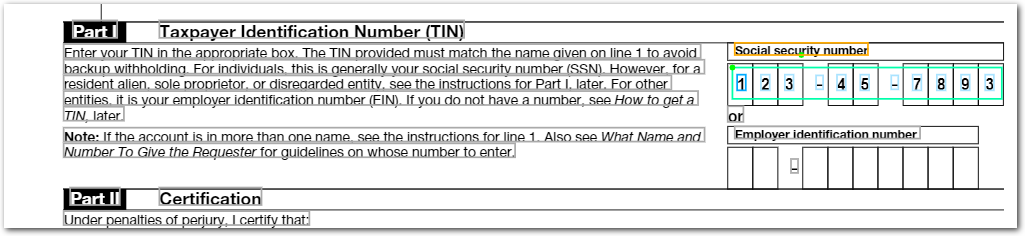
| Example document | Download link |
|---|
Output
{
  "SSN": {
    "type": "string",
    "value": "111 – 22 – 3333"
  }
}
Notes
If the region that you want to extract is a box that's bordered with dark lines, you can use the Box method instead of the Region method.
Updated 9 days ago